
Establishing clear ownership, defined responsibilities, and a consistent process for managing website requests helps ensure that your public site remains accurate, current, and aligned with your League's communications strategy.
Your Website, Communications, or Marketing Committee may have several members involved in managing your League's digital presence. However, committee membership does not necessarily mean every member needs direct access to the WordPress website.
The most effective website governance structures clearly distinguish between who requests changes, who approves changes, who manages content, and who has access to the website itself.
1. Establish Clear Website Ownership
Start by identifying who is ultimately responsible for the League's public website.
Your League should designate:
A primary website owner or point of contact.
A backup contact to provide continuity when leadership changes.
Individuals responsible for approving website content.
Individuals responsible for making website updates.
A process for communicating website-related questions or issues to AJLI Website Support.
The person responsible for website governance does not necessarily need to complete every website update themselves. Their role may instead be to coordinate requests, prioritize work, ensure content is accurate, and make sure the appropriate person completes the update.
Consider defining responsibilities such as:
Website Owner
Oversees the overall public website.
Coordinates website priorities and governance.
Ensures appropriate access is maintained.
Serves as a primary point of contact for website-related matters.
Content Owners
Maintain content for their assigned areas of the website.
Ensure information is accurate and current.
Submit or communicate updates through the League's established process.
Website Editors
Make approved updates within WordPress.
Follow AJLI's template and website best practices.
Perform quality checks before and after publishing.
Approvers
Review content before publication when required by the League's governance process.
Ensure content aligns with League policies, communications standards, and brand guidelines.
2. Limit WordPress Access to the People Who Need It
One of the most important governance practices is to avoid giving WordPress access to everyone involved with your website or communications efforts.
A League may have a Website Committee with several members, but only a smaller number of people may need direct access to WordPress.
Before granting access, ask:
Does this person need to log into WordPress to perform their assigned responsibilities?
If the answer is no, they may be better served by submitting requests through the League's website or communications intake process.
Why limit access?
Maintaining a smaller group of WordPress users can:
Reduce accidental changes.
Make it easier to identify who made an update.
Create greater consistency in website management.
Simplify training and onboarding.
Make leadership transitions easier to manage.
Reduce the risk of outdated users retaining access after their volunteer term ends.
Review access regularly
League leadership and website owners should periodically review WordPress users and remove access for individuals who are no longer serving in roles that require it.
This is especially important during annual leadership transitions. For more insight on access and user roles, please see this support article: WordPress User Roles and Access for Leagues
3. Create a Website Request Process
Not every website update needs to come directly from a WordPress user.
Establish a consistent process for members, committees, and League leaders to request website updates.
Your request process might use:
A Member Essentials form.
A Microsoft Form or other internal form.
A designated email address.
A project-management or ticketing system.
Another centralized request process established by your League.
The specific tool is less important than having one clearly communicated process.
A website request should ideally include:
Requester's name and committee.
Page or section of the website affected.
Description of the requested change.
Exact copy or information to be added/removed.
Images or other assets, when applicable.
Desired publication date or deadline.
Any necessary approval information.
Centralizing requests also makes it easier for the website team to prioritize work and prevents requests from being lost across individual emails, text messages, meetings, or direct messages.
4. Separate Website Requests From Broader Marketing Requests
Some Leagues manage website updates as part of a larger marketing and communications request process.
This can work particularly well when the League receives requests involving multiple communication channels, such as:
Website updates
Email/e-blast requests
Social media
Graphic design
Public relations
Event promotion
A League may choose to use one master communications request form and then route requests to the appropriate person or team.
Other Leagues may find it more effective to maintain a dedicated website request process.
There is no single required structure. The important thing is that your League clearly defines where requests should go and who is responsible for handling them.
5. Define a Standard Website Workflow
Once a request is submitted, establish a predictable workflow.
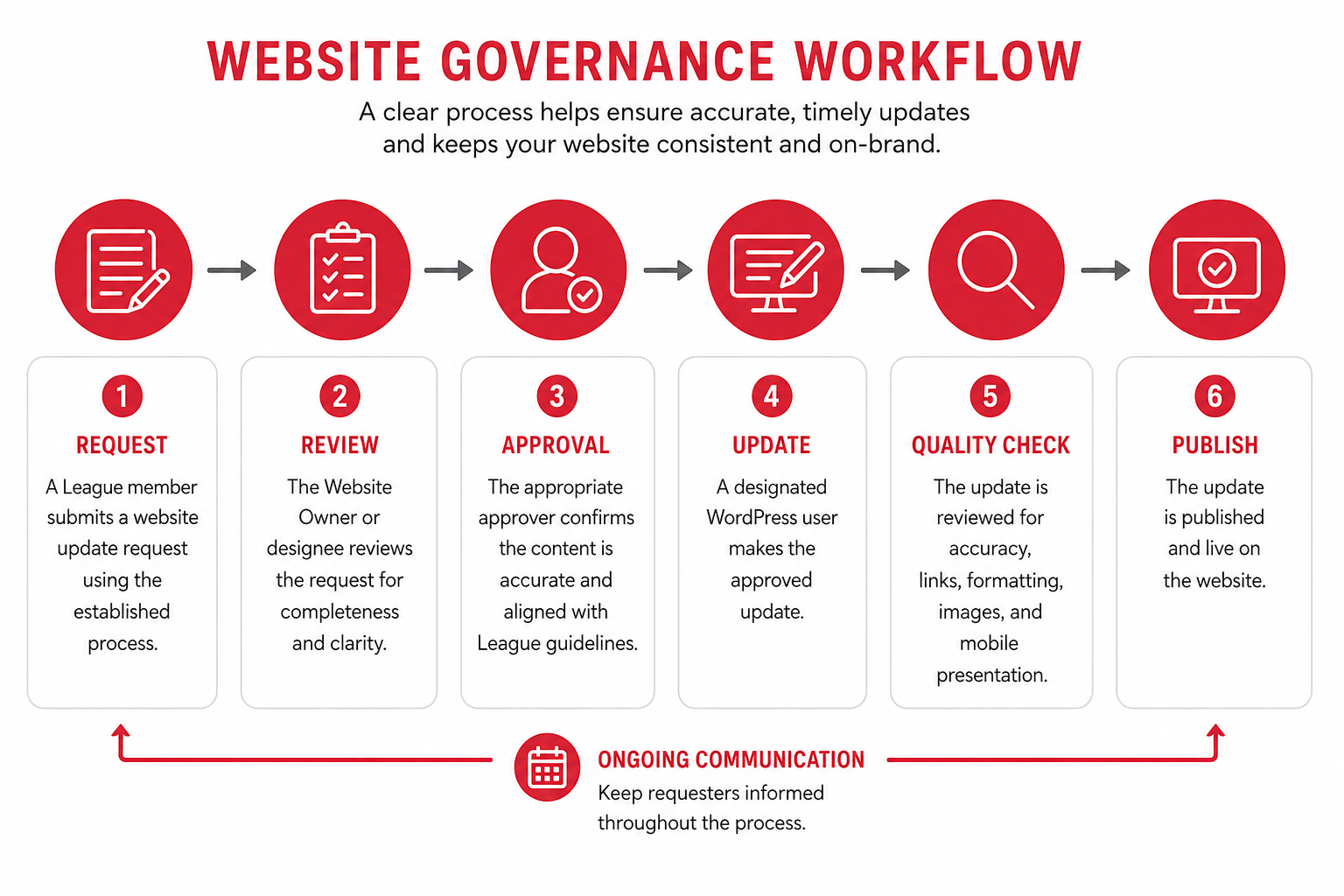
A simple process might look like:
Request → Review → Approval → Update → Quality Check → Publish
For example:
A committee member submits a website update request.
The Website Owner or designated reviewer confirms that the request is complete.
The appropriate content owner approves the information, if required.
A designated WordPress user makes the update.
The update is reviewed for accuracy, links, formatting, images, and mobile presentation.
The change is published.
This process helps prevent the website from becoming a collection of individually managed pages with inconsistent information.
6. Use Member Essentials to Reduce Duplicate Work
When information already exists within Member Essentials, determine whether it can be managed through the appropriate Member Essentials functionality rather than manually recreating the same information on the public website.
For example, some Leagues use Member Essentials functionality to manage meetings and events and configure information so that it can populate the public website.
Reducing duplicate data entry can save significant time and reduce the likelihood of inconsistent information appearing in multiple places.
7. Document Your Governance Process
Your League should maintain a simple website governance document that explains:
Who owns the website.
Who has WordPress access.
What each user is responsible for.
How website requests are submitted.
Who approves different types of content.
How urgent requests are handled.
How content is reviewed.
How users are added and removed.
What happens during annual leadership transitions.
Your governance document does not need to be complicated. Its primary purpose is to make expectations clear and provide continuity when volunteer leadership changes.
8. Plan for Annual Leadership Transitions
Junior League leadership changes frequently. Your website governance process should be designed around that reality.
At the end of each League year, review:
WordPress users and roles.
Website committee membership.
Website ownership.
Primary and backup contacts.
Content responsibilities.
Outstanding website projects.
Documentation and training needs.
Avoid building a process that depends entirely on one person knowing how everything works.
A strong governance model allows a new Website Chair or Communications VP to understand who does what, how requests are handled, and where website responsibilities live without having to rebuild the process from scratch.
What Other Leagues Are Doing
Leagues use a variety of approaches to manage website and communications requests.
Some Leagues use Member Essentials forms to collect communications requests and route them to the appropriate person or team. Others have moved toward having individual council or committee leaders submit or manage information directly rather than relying on one person to enter everything.
Some Leagues maintain a dedicated website request form for corrections, updates, and homepage promotions, while using a broader marketing request form for social media, graphics, email, and other communications needs.
These approaches demonstrate an important principle:
There is no single "correct" governance model. The goal is to create a system that clearly defines responsibilities, limits unnecessary access, and gives members an easy way to request changes.
Recommended Starting Point
If your League is transitioning to a Member Essentials Public Website, start with these five decisions:
1. Who owns the website?
Identify one primary owner and one backup.
2. Who actually needs WordPress access?
Review responsibilities rather than automatically granting access to everyone on the Website or Communications Committee.
3. How will requests be submitted?
Choose one centralized process and communicate it clearly to League members and leaders.
4. Who approves content?
Define whether requests require committee, staff, executive, or other leadership approval before publication.
5. What happens when leadership changes?
Document the process and review website access and responsibilities annually.
A clear governance structure will help your League get the most out of the Member Essentials Public Website while reducing confusion, duplicate work, and unnecessary administrative access.